

CBK Made Me Depressed
This isn't about her Prada jacket...


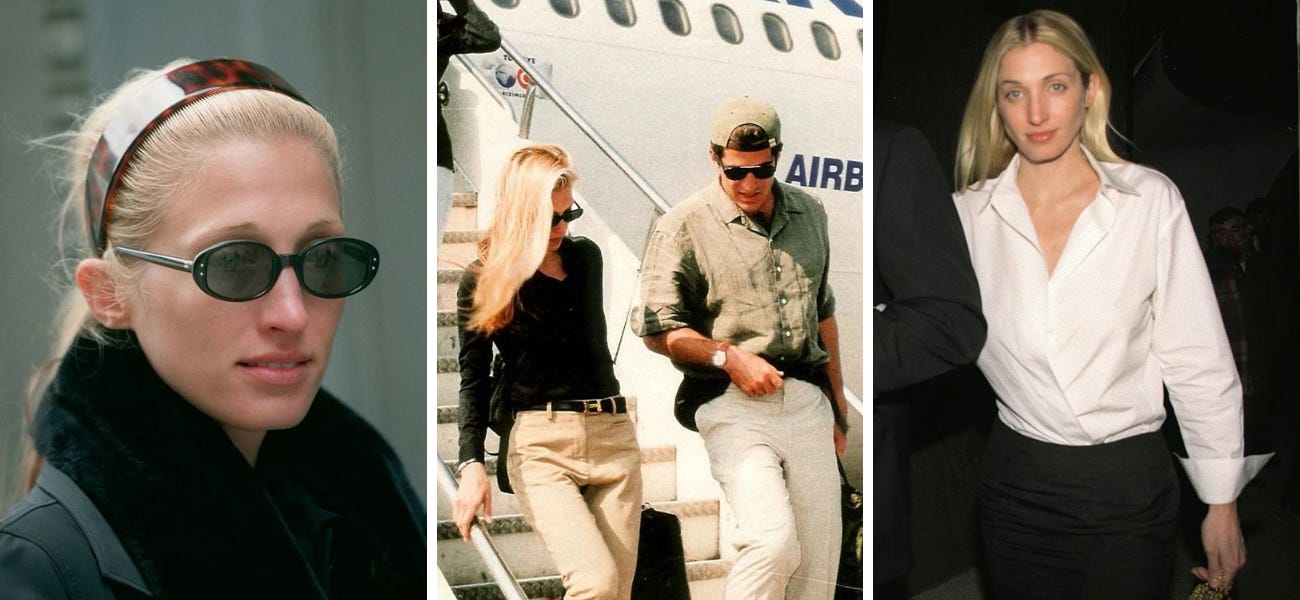
I have never been a casual television watcher.
Instead, my empathic pores get blurred and a part of my psyche enters the fictional world that the pixels on my screen are projecting; that the actors of the show are convincing me of.
My boundaries get blurred. I lose my center slightly. I suddenly live in their world.
Love Story: John F. Kennedy Jr. and Carolyn Bessette has been no exception. I have utterly, deeply, and without reservation, fallen into their world along with every other cultured and creative individual of America.
I have been swallowed whole by sadness, insecurities, existential envy. While the world is fixated on CBK’s style (and even JFK Jr.’s - the hats! the ties!), their love story has hit upon the many existential, cultural, and philosophical tragedies that my heart has been grappling with from a young age.
Themes and poignant fragilities like nostalgia, body types in fashion, cultural scenes, the allure of mystery.
Carolyn Bessette has prompted the well within me: the well of the blues.
Let’s go down the list - one by one - and talk about what JFK Jr. and Carolyn Bessette’s relationship really means (beyond her iconic Prada jacket).
Minimalistic Fashion vs. Romantic Body Silhouettes
Here’s my unpopular opinion: CBK’s style isn’t actually that impressive.
Everyone wears blue jeans and a white tee. Everyone wears a black silk dress. What people are responding to isn’t the clothes; it’s the energy, the blonde, the height, the body. Because here’s the truth nobody wants to say out loud: when you are tall and slender with nothing to hold on to, things simply hang on you effortlessly. The clothes don’t have to work very hard.
Lauren Santo Domingo once argued that CBK wasn’t making some grand gesture of minimalism and restraint. She was just a fashion girl on a fashion budget who invested in a few good pieces and rewore them. And I believe that. The mythology we’ve built around her wardrobe says more about our collective projections than it does about her actual style. What I’m more interested in is the question underneath all of it: What would that wardrobe look like for women who actually have women’s bodies? Hips, waists, curves, something to hold on to. The CBK aesthetic, the Prada minimalism, The Row simplicity…all of it designed as though the female body is just a hanger. I want that world of effortless, intentional, and minimalistic dressing to exist for the curves of a female body too.
In that, CBK’s style has brought something sensitive to the surface for me. There is a war I have been fighting quietly for most of my life: The war between the girl I am and the girl I dress for in my head. My style has always lived in a certain world: minimalist, clean, Prada, The Row, that effortless 90s simplicity. But my body has always lived somewhere else entirely. I have a romantic body type…hips, waist, breasts, curves… and the clothes that actually fit me, that actually work, tend to be sexier, more fitted, more overtly feminine.
And here is the confusing part: when I put those clothes on, I feel incredible. The fit is right, my body feels celebrated, I exude beauty. But then I look in the mirror or take a photo and I think…that's not the girl I’ve always wanted to be. The outfits I save and pin, the looks I am drawn to, the aesthetic I have always called my own…they are not meant for my body type.
That's the identity crisis nobody really talks about: When your taste and your body are simply not in conversation with each other. I have spent years being jealous of women like CBK not because of who she was, but because she could just put on simple things and exude an it-girl aura of effortlessness. For some of us, dressing is never that easy. For some of us, it has always been more of a hunt, an identity crisis, a love-meets-insecurities, a trial-and-error, an endless quest for the right fit.
Nostalgia
The nostalgia of the 90s! Calvin Klein! Kate Moss! Minimalism! Vogue!
Nostalgia is a brutal thing; painful, and ultimately helpful to no one. When we romanticize figures like CBK and JFK and the time period in which they occupied, we have to remind ourselves: it's not real. None of it is. It's just hindsight dressed up as truth. Nostalgia is simply another way of being at war with your present reality…no different, really, from superhero movies or any other form of escape. We tell ourselves, “It was a better time, these things were better, there was no social media, the fashion was the height of sophistication.” What we're actually doing is painting an illusion. The way we view and talk about the past is so far from what reality actually was. And yet…my heart has consistently and masochistically lived there. It is a tortured illusory hell that I romanticize, that I (dare I say) makes me feel interesting, cultured, and sophisticated.
However, in the end, it glorifies the past through a level of hindsight that will never allow our present day reality to be fulfilling. It causes me pain.
I ask myself: Did CBK know she was at the height of a cultural movement? That she was at the center of it all? That she would be known as an icon? And if she didn’t, is there actually something to romanticize here? Is nostalgia real if the people living through it didn’t realize it’s importance in the moment?
Cultural Scenes
There is a particular kind of longing that goes beyond general nostalgia; a wish not just for a different era, but for placement within it. To have been 23 and there, inside a scene, living inside a cultural moment as it was actually happening. CBK didn't manufacture her iconicity; she was simply dropped into the right room at the right time…Calvin Klein, the Kennedys, New York in the 90s…and the world tilted around her. That kind of placement is not a product of ambition or strategy. It's not something you can work toward or will into existence. And that's what makes the longing for it so quietly devastating…because you can want it with everything you have and it still won't come. The scene chooses you, or it doesn't. The moment finds you, or it passes. And most of us are left watching from the outside, romanticizing a room we were never in, wondering what it would have felt like to just be there. Whether it’s Joan Didion and Eve Babitz or the Hemingway and Fitzgerald scene. A scene is a scene.
I have a deep urge to be a part of and a deep fascination of scenes: cultural, historical, artistic scenes.
However, for those who have found themselves in the good old days of a cultural scene…do they know they are in within one at the moment? Or are we only relating to movements through nostalgia?
The Allure of Mystery
One of the primary reasons we are all utterly obsessed with CBK is the mystery around her. Why did she dress in such minimalistic restraint? Who was the woman that captured America’s most eligible bachelor’s heart not willingly but skeptically? Where does her allure lie?
Her tragic death perpetuates and grows this mystery ten fold. The public had access to her - albeit through tabloids - and then that access was revoked through her death.
Mystery only grows, matures, and becomes permanent when access is revoked.
Being mysterious as a reputation is one that I have been obsessed with since I was young. A want of mine. A desire to be seen as mysterious. An utter failure to be so as a podcaster and writer.
There is a fantasy many of us currently carry: to be offline, to be mysterious, to prioritize the analog. However, I have come to learn that you cannot be mysterious unless you are already known. The Olsen twins are the perfect example. Their mystique, their untouchability, the whole mythology of The Row…none of it exists without the eighteen years they first spent giving us everything. They built the audience and then they revoked our access to them. Now, the only way for us to enter into their world is to wear The Row.
CBK is perhaps the greatest proof of this. Everyone on the internet romanticizes her privacy, her reluctance, her refusal to perform…but if she were alive today and actually living that way without being chosen by a famous man in the spotlight, we would not know her name. She would just be someone who used to work at Calvin Klein. No name, no impact, no icon. The very qualities we celebrate her for would have made her completely invisible.
And so when I say I want to be mysterious, I have to be honest with myself about what I'm really saying.
It's not a desire to disappear. It's still rooted in ego, still rooted in the want to be known; just on my own terms, in my own way.
The want to be mysterious is still a want to be known. It's just a specific way of asking to be recognized, with the illusion of control over how.
So here we are. Stuck in a sea of content of CBK style moodboards, talking head reels of what CBK would like today, shopping edits of how to look like CBK today.
But above all…maybe it’s not about recreating CBK and her iconic style. Maybe it is finding the thing that makes us that girl. Our own energy of effortless. Our own magical allure.
It is easy to step-and-repeat CBK’s style.
It’s harder to look within, find your own magical essence, and dream into that.
As I threw on a white babydoll dress that looks slightly like a nightgown, slipped into my Havianas, grabbed my blue vintage snakeskin tote filled to the brim with my laptop, notebooks, lip balm, glasses, and hand cream, got into my car, rolled down the windows, and blasted Stevie Wonder…I felt like that girl.
And in that moment, I realized: It isn’t CBK we are desperately trying to become.
It is us we are trying to become. We are just too scared to be that girl, so we default to becoming her. We use her formula. We remove our jewelry. We buy the Prada bag.
And that’s why she is an icon.
If we ditched her formula and used our own, we would be too.
loved this and found myself nodding along to so much of it. funny enough, i’ve always been on the taller, leaner side and spent years wishing i felt more feminine. different sides of the same coin, maybe. either way, honoring what we’ve got really is the work 🫶
what is the big deal with her? everyone i knew dressed like this in the 90s … enough.